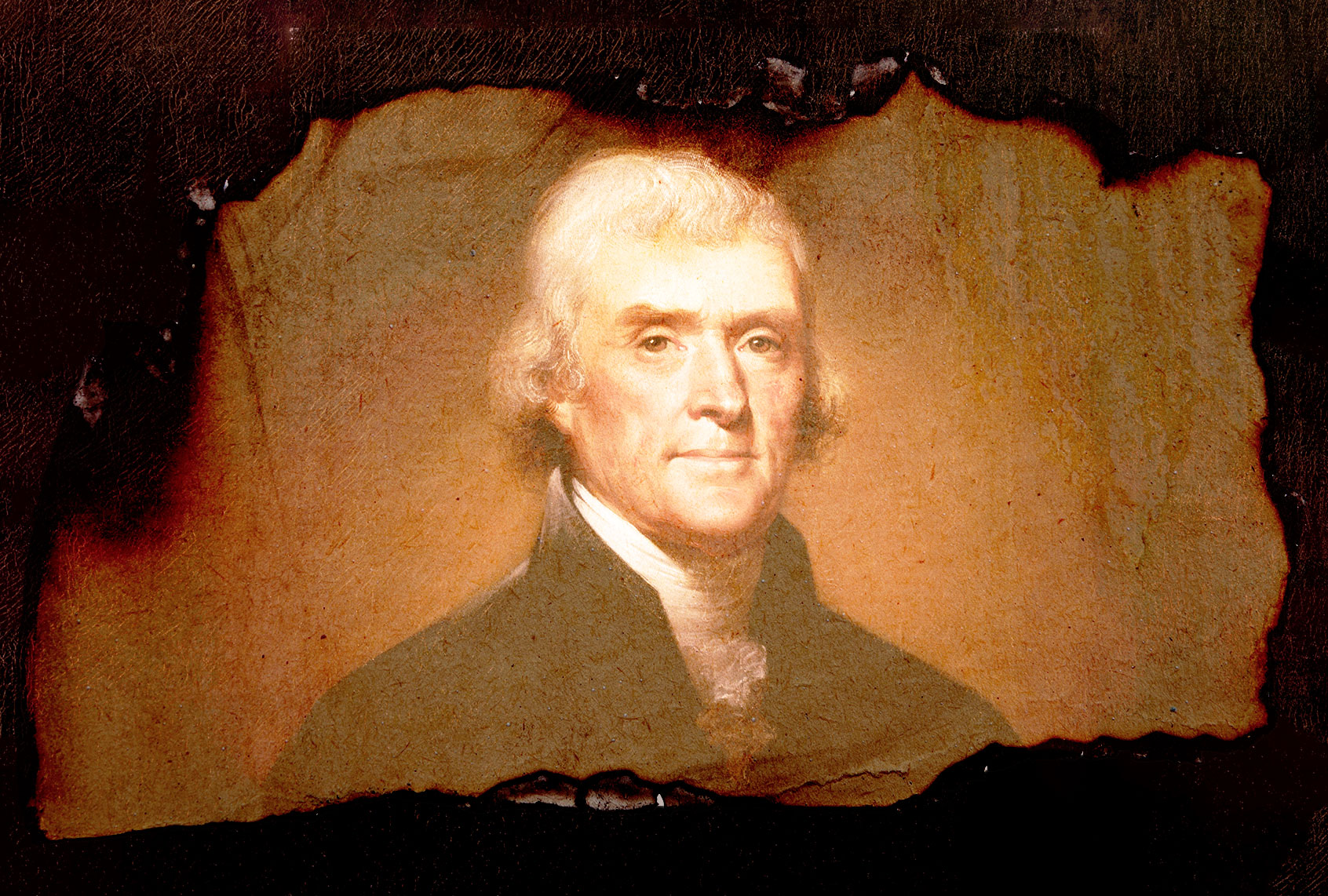
Dorothy Westerinen celebrated the Fourth of July the way she usually does, by barbecuing and hanging out around the pool with her wife and close friends. But her relationship to America’s founding, particularly this year’s semiquincentennial, is far from usual. Through her late mother, Julia Jefferson Westerinen, Dorothy is a direct descendant of Thomas Jefferson, the third president and principal author of the Declaration of Independence, and Sally Hemings, the enslaved woman of African extraction who bore him children.
“My heritage was very much on my mind,” the 68-year-old Long Island, New York, resident said. “Although I didn’t share those thoughts with anybody, my friends all know my story.”
Many others do too. In 1998, scientific analysis of a DNA sample from Dorothy’s maternal uncle confirmed that her third great-grandfather, Eston, was Jefferson’s youngest child by Hemings.
“It’s common knowledge now among anybody,” said Art Westerinen, 64, the family historian and one of Dorothy’s three brothers. Case in point: In a viral video from 2024, an inebriated reality-television personality referred to herself grandiloquently as “Thomas Jefferson’s concubine.”
“There are still deniers, unfortunately,” Art said. “But, generally, it’s accepted as: ‘This is the truth.’”
Eston Hemings was born on May 21, 1808, and raised in slavery at Monticello, the Jefferson plantation in Virginia. Emancipated at 21, he moved to Ohio, then Wisconsin, where he and his half-Black, half-Jewish wife, Julia (née Isaacs), changed their last name to Jefferson and began passing for white. Eston’s decision led to estrangement from his brother Madison, the only one of the four surviving Jefferson-Hemings offspring to remain in the Black community.
(Courtesy of Jane Feldman Photography and the Westerinen family) Dorothy Westerinen (R), stands with her mother Julia Jefferson Westerinen (L), at Monticello in 1999
“Eston cut off ties with his whole family,” Dorothy said. “I would cut my arm off first. But, you know, he — I mean, we — benefited from it, certainly.”
Unyoked from racial prejudices and prohibitions, Eston’s progeny prospered. Four generations later, the Westerinen children were growing up on Staten Island as mainstream white kids, free of stigma beyond maybe their surname of Finnish origin, which was considered exotic in a sea of Italian, Irish and Jewish last names.
But Dorothy and her youngest brother Marshall Westerinen, now 62, had another truth to be spoken — about their sexual identities. To the best of their knowledge, they are the only openly lesbian and gay direct descendants of Jefferson and Hemings. As they celebrate America’s 250th birthday, they are also contemplating the relevance of their orientation to the nation’s conception of itself.
I first met the Westerinen family in 1999 as a graduate student in New York City, writing my thesis on the rise of genetic genealogy. In the wake of their DNA test results, the family was all over the media. Somehow, I found their phone number, and Julia, the matriarch, graciously agreed to my request for an interview. Dorothy and Marshall, then 40 and 34, picked me up at the ferry landing on Staten Island and drove me to the family home where their mother and Shay Banks-Young, one of their African American cousins descended from Madison with whom they had just reunited, welcomed me.
We all sat around the dining table for a lengthy discussion on racial identity. But my gaydar was also going off big-time around Dorothy and Marshall, news they found amusing when I told them recently. I did not broach the topic despite thinking it might be a meaningful angle to explore. There was no way to gauge the reaction in the room. It was a different time. While LGBTQ+ voices were far from silent, especially in a city like New York, the idea that their perspectives could inform broader conversations was not as widespread as it has become.
Twenty-seven years later, ahead of the semiquincentennial, I reconnected with Dorothy and Marshall, who happily confirmed they are, and have for decades been, out and proud. “The two worlds have rarely met, in terms of being gay and also being a direct descendant,” Marshall said. “Not only because of the respective communities, but because of me and how I don’t really talk about it unless it comes up.”
The siblings do not regard themselves as activists for the LGBTQ+ or any other community, just people raised to be “accepting of everybody,” Dorothy said.
(Courtesy of the Westerinen family) Marshall Westerinen
“Queer folks, and multiracial people are not going away, and rainbow families,” Marshall said. “Whether we’re quiet about it, or whether we’re activists, or whether we’re doing our own small part of keeping people aware or just being who we are, [it] is a political statement.”
What impact could Dorothy and Marshall’s existence as queer direct descendants of the Declaration’s author have on attitudes towards LGBTQ+ Americans in the present and future?
“You don’t know what your siblings are,” Art said. “Maybe they’re hiding something that they’re ashamed to admit because of who you are, what you put forth in the world.”
Nine percent of the U.S population openly identifies as LGBTQ, double the percentage fourteen years ago. Yet a Gallup poll released last month finds support among U.S. adults for LGBTQ+ issues in decline. The 62% of respondents who said they view same-sex relations as moral is the lowest since 2016. This backslide is most pronounced among Republicans, according to Gallup senior editor Jeffrey M. Jones: “Since 2022, the high point for Republicans, the share who say such relations are morally acceptable has fallen 21 points to 35%, compared with an eight-point decline among independents to 64% and no meaningful change among Democrats (now at 81%).”
Such polling did not exist at the time of the American Revolution, but historical records show queerness did. Many believe Jefferson’s frenemy Alexander Hamilton had obvious romantic inclinations toward John Laurens, a military strategist for George Washington.
Such polling did not exist at the time of the American Revolution, but historical records show queerness did. Many believe Jefferson’s frenemy Alexander Hamilton had obvious romantic inclinations toward John Laurens, a military strategist for George Washington. Whether Jefferson had any knowledge or opinion of Hamilton’s fondness for Laurens is unknown. The only tangible clue to Jefferson’s stance on queer sexuality in general is Bill 64, a piece of legislation he introduced to the Virginia Assembly in 1779 containing a proposal to reduce the punishment for sodomy from death to castration for men and nose-cutting for women.
This was a liberal proposition for the era. It did not pass. But, while drafting it, had Jefferson considered the possibility that the flesh of his own flesh could one day suffer such mutilation?
“I’m not sure what they would have thought as far as having gay descendants,” Dorothy said of her distant grandparents. “Thomas Jefferson was a man of the world. I’m sure he knew gay people. Sally Hemings was enslaved, so I would think she’d be more empathetic because of being an outcast and an outsider.”
“There’s no way to know for sure, no way to even investigate,” Marshall added. “The categories didn’t exist as they do today.”
Five generations later, Dorothy said she has never concealed her orientation at Jefferson-Hemings family gatherings, often bringing her wife of over 35 years. “My partner came along with us to a lot of these events and stuff, and, you know, they gave her just as warm a hug as they did me,” she said, noting that some of her relatives are quite religious. “It didn’t seem to be an issue. But, again, I don’t know what people said behind closed doors.”
In recent decades, scholars and community leaders have turned up the volume on homophobia in the African American church, addressing debates such as opposition to the legalization of same-sex marriage. Some historians have also begun to examine the period of the American Revolution through an LGBTQ+ lens.
Our Summer sale is on!
Within the Jefferson-heritage establishment, race remains an issue. The Thomas Jefferson Foundation, which owns Monticello and runs its public educational programs, gradually came around to acknowledging the full subjecthood of Sally Hemings, to the chagrin of some visitors. “Indeed it is the Sally Hemmings [sic] show up there,” wrote one disgruntled tourist on the official Monticello Facebook page, also resenting the mention of queerness. “My guide even talked about LGBTQ rights on the last tour…Ridiculous.”
A struggle also remains for Jefferson-Hemings descendants to gain the right to be buried in the Jefferson graveyard. The Monticello Association, comprised of Jefferson’s descendants from his wife, Martha Wayles Jefferson, controls the graveyard and voted overwhelmingly to ban Hemings descendants, as detailed in a personal essay by Salon contributor Lucian K. Truscott IV, a cousin of the Westerinens on the Jefferson side. The irony is that Sally was also Martha’s half-sister — the product of John Wayles’ relations with an enslaved woman — making her biological kin to the Monticello Association members, too.
With the visibility of Dorothy, Marshall and future openly queer descendants, will a time come when LGBTQ+ perspectives are formally recognized at Monticello? The siblings are undecided.
“Whatever attention this brings,” Dorothy said, “I cannot be anything but myself.”
“Any family tree is going to be filled with colors,” Marshall added. “If you look hard enough.”